

The Shame No One Talks About After an Affair
It's 1 a.m. The house is quiet, but neither of you is asleep.
One of you is replaying the texts again. The other is staring at the ceiling, thinking, How did I become this person? You're lying a foot apart, and each of you feels completely alone.
If this sounds familiar, you're not the only couple going through it.
The short answer: After an affair, shame, not just anger, is often what keeps couples stuck. The partner who had the affair may shut down to avoid facing what they did. The partner who was hurt may quietly wonder what's wrong with them. Healing begins when both of you can step out of hiding, with the right support.
Shame and guilt are not the same thing
Most of us use these words interchangeably, but researchers who study emotions draw a clear line between them.
Guilt says: "I did something bad."
Shame says: "I am bad."
That difference matters more than it sounds. Guilt focuses on a behavior, and behaviors can be changed and repaired. Shame focuses on who you are, and that feels much harder to fix.
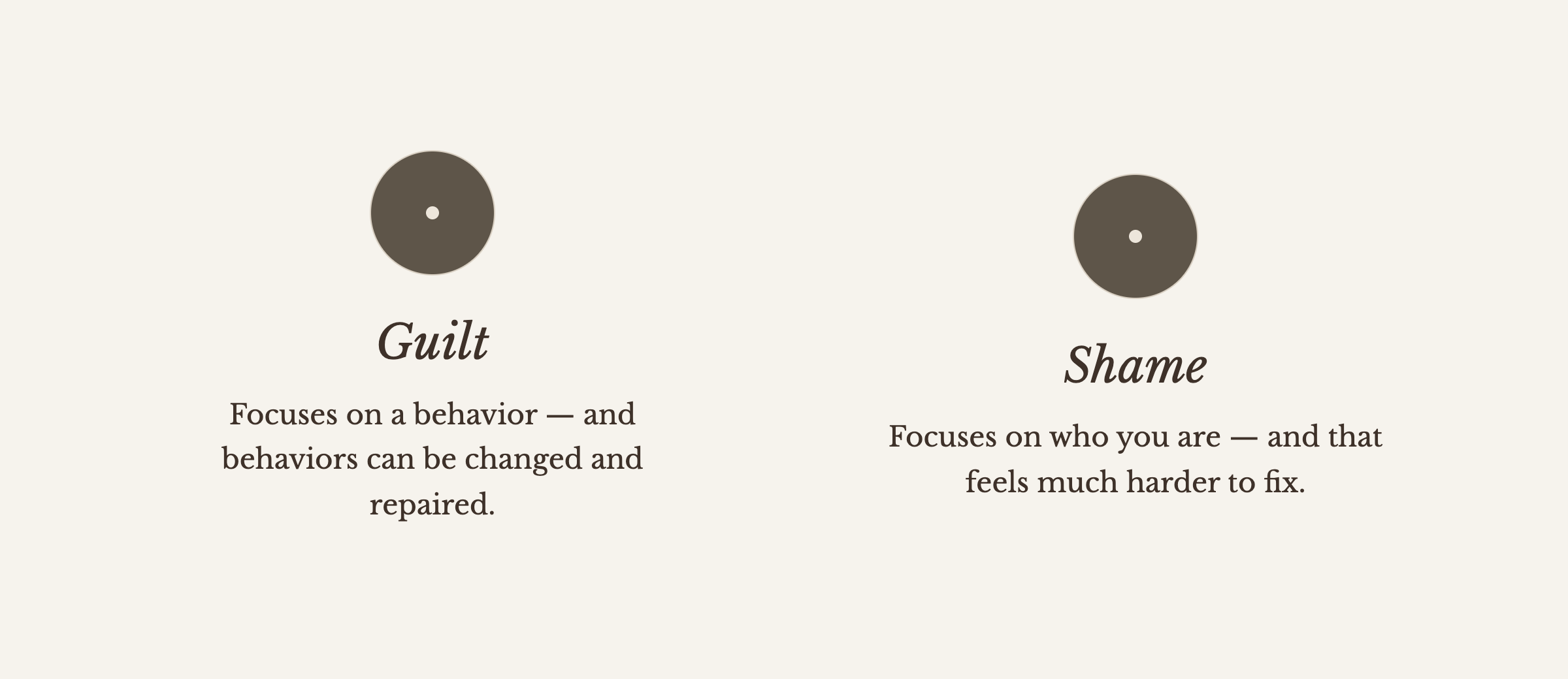
Guilt vs Shame
So guilt tends to move people toward apologizing and making things right. Shame tends to make people want to hide, defend themselves, or disappear (Tangney, Stuewig & Mashek, 2007).
After an affair, both partners often end up living in shame instead of guilt. That's where couples get stuck.
Why does the partner who had the affair shut down?
If you're the one who had the affair, you may notice yourself doing things that make everything worse:
Giving short answers, oftentimes coldly.
Getting defensive when questions come up again.
Saying "Can we please just move on?"
From the outside, this looks like you don't care. Often, the opposite is true. You care so much, and feel so disgusted with yourself, that looking directly at the pain you caused feels unbearable. So you look away.
The problem is that your partner needs you to look. They need to see you stay present with their hurt without collapsing or running. Moving from "I am a terrible person" to "I did something that deeply hurt you, and I want to understand it" is often the first real turning point.
Sometimes shame doesn't look like shutting down at all. It looks like anger. You might hear yourself snap, "How many times do we have to go over this?" or "You're making this way bigger than it was." You might deny things you know are true, or turn it back around: "Well, if you had paid more attention to me…" In the moment, it feels like protecting yourself.
Often, it's shame wearing armor. Research has found that people who are more prone to shame are also more likely to respond with anger and blame, possibly because pointing outward hurts less than looking inward (Tangney et al., 1992). The problem is that to your partner, anger and denial can feel like the betrayal happening all over again: one more moment where the truth isn't safe with you.
Why do I feel ashamed when I'm the one who was hurt?
This is the shame people rarely talk about, and it can be very confusing. You didn't break the trust, so why do you feel so small?
The hurt partner's shame often sounds like:
"Wasn't I enough?"
"What would people, what would my family, think if they knew?"
"Who am I, checking phones and crying in the car?"
"Am I weak for even considering staying?"
Many hurt partners also have reactions that feel out of their control. Painful images pop into their mind, they're constantly on alert, and they need to ask the same questions again and again. Affair researcher Shirley Glass described these as trauma-like reactions to betrayal (Glass, 2003). They aren't a sign that you're "not letting it go." They're your mind and body trying to feel safe again.
Why do we keep having the same painful conversation?
Many couples fall into a loop that looks something like this:
The hurt partner reaches out with questions, anger, or tears.
The other partner, flooded with shame, goes quiet or gets defensive.
The hurt partner feels dismissed and pushes harder.
The other partner shuts down even more.
Round and round it goes. Both of you end up feeling more alone.
In Emotionally Focused Therapy (EFT), the approach I use, we don't treat either of you as the "problem." The loop, where you have been stuck in, is the problem. Once you can both see it, you can start working against it together, instead of against each other.
When your family says "don't talk about it"
In collectivistic culture, many of us grew up hearing some version of 家醜不可外揚: don't air the family's shame to outsiders.
That value can protect a family's privacy and dignity. After an affair, it can also mean suffering in complete silence. You can't tell your parents or your friends. Sometimes even the idea of seeing a therapist feels like a betrayal of the family.
A few other things often show up for Chinese-American couples:
Face (面子) and family expectations. There may be fear of parents finding out, or pressure to "stay for the kids" or to keep up appearances.
The dual-income gap. When two busy professionals are managing a mortgage, careers, and children, the relationship can quietly become an efficient partnership with little emotional closeness left. That doesn't cause an affair, but it can leave a gap where one grows—often seen in high-achieving couples in New York City.
Two languages, two kinds of apology. A quick “sorry” can feel very different from a full, heartfelt apology. Some feelings are simply easier to say in English, others in Mandarin. Having the space to use both can help things finally get said.
Not every couple experiences all of this, but if any of it fits, know that it makes sense, and that it's something you can talk about.
What does rebuilding trust actually look like?
EFT has a specific approach for this kind of deep hurt, sometimes called an "attachment injury" (Johnson, Makinen & Millikin, 2001). In everyday language, it goes something like this:
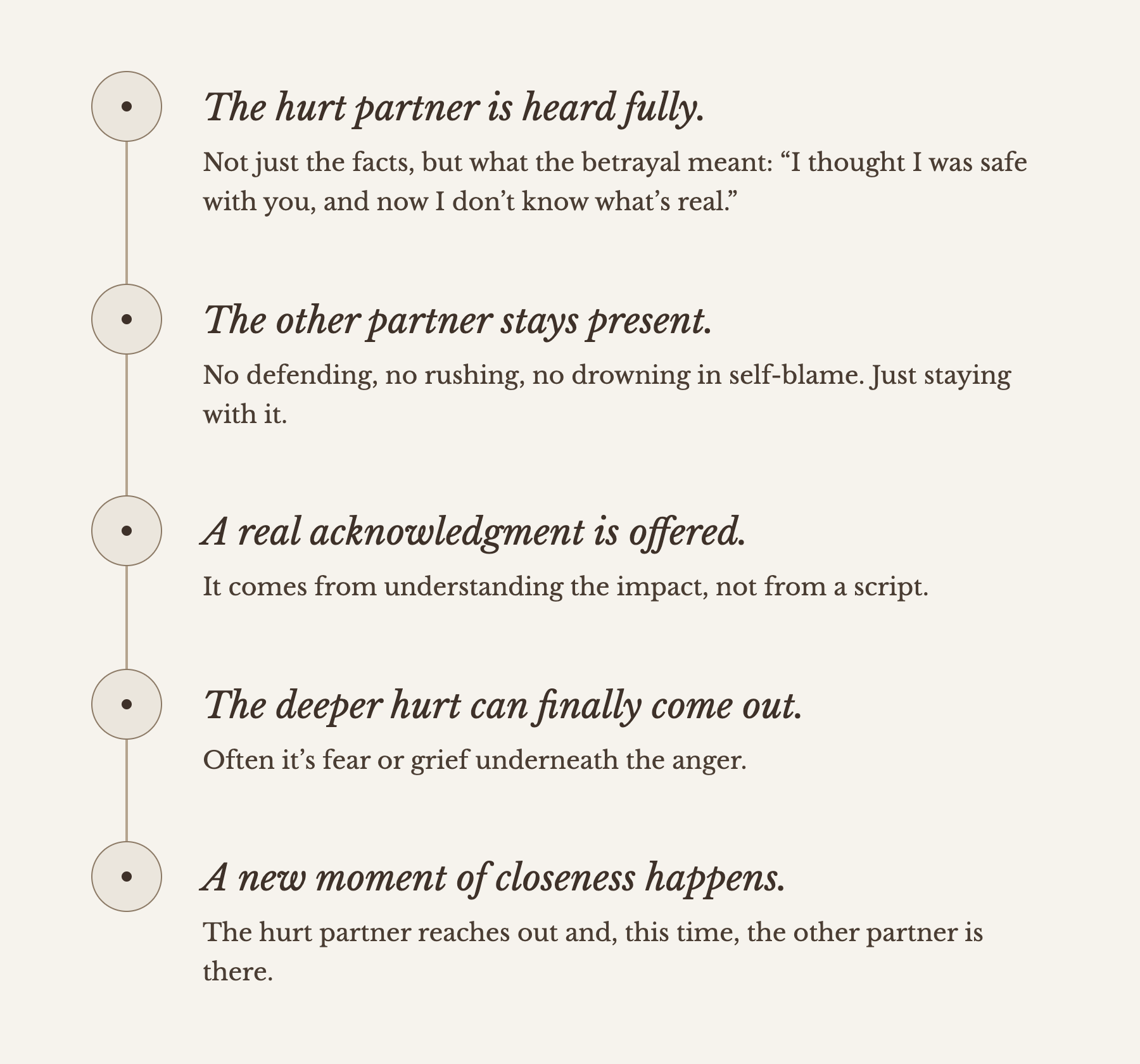
The five steps: (1) the hurt partner is heard fully; (2) the other partner stays present; (3) a real acknowledgment is offered; (4) the deeper hurt can finally come out; (5) a new moment of closeness happens.
That last step matters most. Trust isn't rebuilt by promises alone. It's rebuilt through new experiences of showing up for each other. Research on this approach shows that many couples are able to work through these injuries and begin to forgive (Makinen & Johnson, 2006).
There's also good news about shame itself. Shame loosens its grip when people believe the damage can be repaired (Leach & Cidam, 2015). Part of what therapy offers is that belief: this is painful, and it's possible to heal.
Signs you're making progress might include:
Hard conversations end with you closer instead of further apart.
The hurt partner has a bad day, and the other partner leans in instead of pulling back.
You both catch the loop sooner: "Wait, we're doing that thing again."
There are small moments of warmth you haven't felt in a while.
You don't have to carry this alone
If you're a couple in New York facing the aftermath of an affair, I offer couples therapy in both English and Mandarin via telehealth across New York. Early-morning and late-evening sessions are available for busy schedules.
Learn more about infidelity and rebuilding trust →
Frequently asked questions
Can a marriage survive an affair?
Yes, many couples do rebuild, and some describe their relationship as more honest afterward. It takes commitment from both partners, and it usually goes better with support.
Should we tell our families?
There's no single right answer. It helps to think about who would truly support you, and to avoid sharing in the heat of anger. If you have children, any conversation with them should be age-appropriate. A therapist can help you think this through together.
How long does affair recovery take?
There's no fixed timeline. It's usually measured in months, not weeks. The hurt partner's need to revisit questions often fades gradually as trust grows.
Do we both need to want therapy?
It helps if you're both willing to try, even if one of you is unsure. Many couples start with mixed feelings.
What’s next?
You and your partner do not have to work through the post-affair recovery and trust rebuilding on your own. Schedule a free consultation to see how an evidence-based and structured approach can help. Also check out the introduction to the Attachment Injury Resolution Model (AIRM) I created for you.
References
Glass, S. P. (2003). Not "just friends": Rebuilding trust and recovering your sanity after infidelity. Free Press.
Johnson, S. M., Makinen, J. A., & Millikin, J. W. (2001). Attachment injuries in couple relationships: A new perspective on impasses in couples therapy. Journal of Marital and Family Therapy, 27(2), 145–155.
Leach, C. W., & Cidam, A. (2015). When is shame linked to constructive approach orientation? A meta-analysis. Journal of Personality and Social Psychology, 109(6), 983–1002.
Makinen, J. A., & Johnson, S. M. (2006). Resolving attachment injuries in couples using emotionally focused therapy: Steps toward forgiveness and reconciliation. Journal of Consulting and Clinical Psychology, 74(6), 1055–1064.
Tangney, J. P., Stuewig, J., & Mashek, D. J. (2007). Moral emotions and moral behavior. Annual Review of Psychology, 58, 345–372.